Wednesday, June 20, 2012
Through the eyes of a toddler
My daughter and her family are staying with us while they are in between homes. While intergenerational living challenges the adults, there are benefits. Kate and Patrick had a place to stay while they waited to move into their new/old house. Kate and I shared grocery shopping and cooking which meant delicious dinners from new recipes. Patrick dug a hole for a new tree in the backyard which my husband and I appreciated. Lance's new knee and my back don't stand up well to hard physical labor. Perhaps, best of all, we shared some wonderful moments with our grandson.
At 21 months old, E. is a whirling dervish falling in love with his world. Although he pushes trucks, throws balls, and enjoys books, the natural world is his best playground. Starlings splashing in rain water delight him. He points out the window and announces "tweet tweet'' when gold finches land at the feeder. Evenings he waters potted plants very seriously and then turns the hose on his parents and plays in the spray. His little body works well so he runs with gusto before suddenly stopping to watch leaves sway in the breeze. The bindweed in our yard doesn't phase him. Instead he runs his thumb over the center of a spent daisy and watches seeds float onto his bare feet. Smelling the neighbors onions makes him giggle. He lingers over cone flowers comparing prickly centers in various stages of bloom. He asks for "more" when a rabbit dares to hop across the trail and out of his sight. When Kate walks in at the end of the day, he grins and shouts "Mama." In the bathtub after a busy day, he hollers to protest the water being poured over his head. Once dry and in pj's, he chooses two bedtime books, listens to them before giving a goodnight pat to his dog and loves to his parents and grandparents.
Kate and Patrick have given E. a wonderful first year and a half. However, he is a toddler so there are still things to learn. He says "no" when he means "yes" and "up" when he wants someone to pick him up out of his high chair in order to get down. Yesterday after his nap, he sat on my lap to read a pile of books. He pointed to turtles, toothbrushes, and dragonflies. A few days ago, he figured out how to turn knob to open the front door. Today, our house is quiet while E. helps his very patient Dad unpack boxes and totes. As for me, I am looking forward to E's discoveries on the other side of the new front door.
Wednesday, May 30, 2012
Garden and Garter Stitch Time of Year
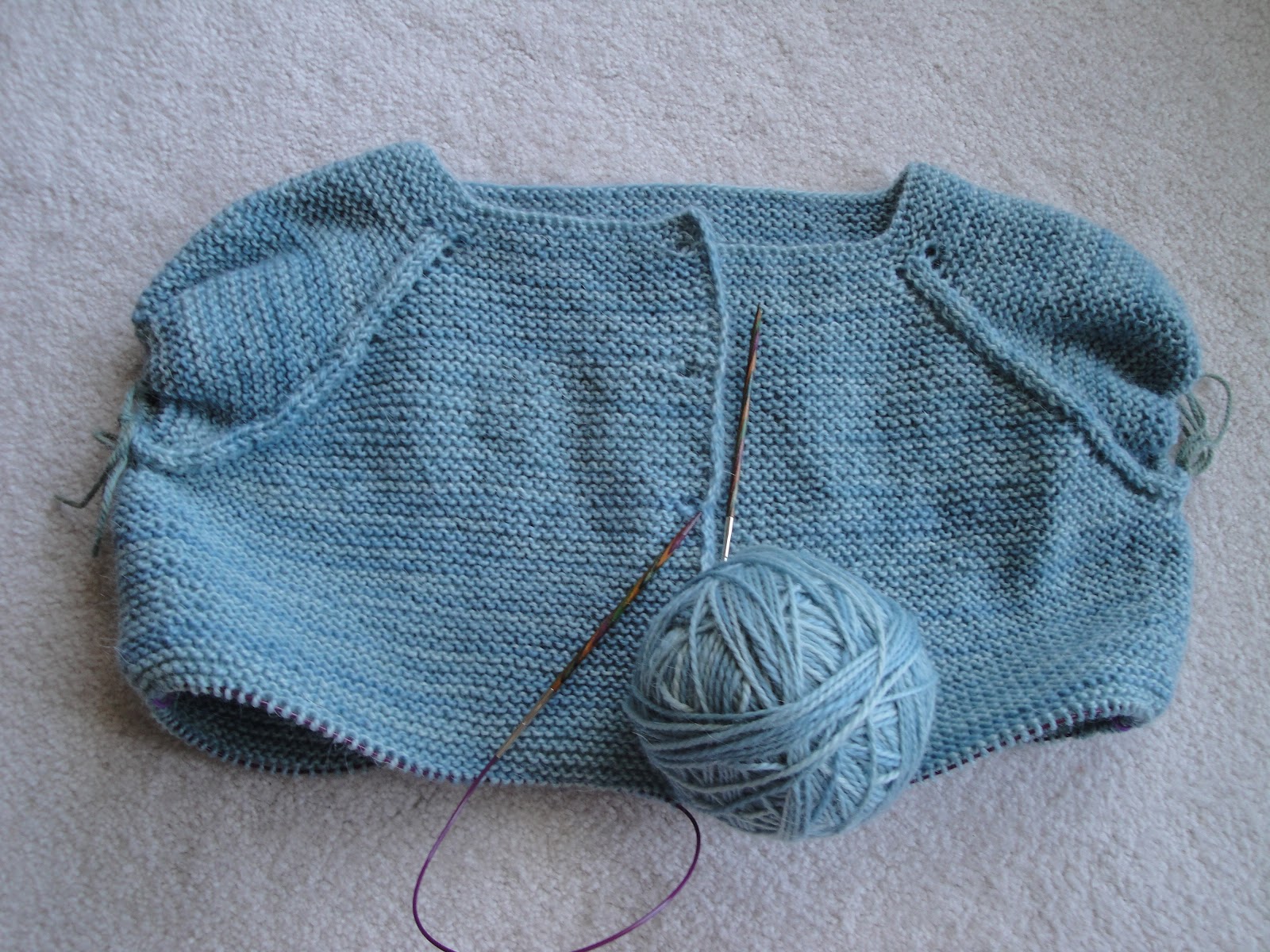
Earlier this Spring, I cast on a Wool Peddler's Shawl in a soft gray shade of alpaca and a Greenfield Cardigan in a soft blue wool/mohair blend. I also had an ever present wash cloth on my knitting needles. All three projects are knit with the humble garter stitch. When I needed a respite from the end of school year paperwork on my desk, I set aside the more complicated Tintern Abbey socks and finished the wash cloth. Then I spent evenings with either the sweater or the shawl. We recently traveled to attend my niece's high school graduation and I worked on the sweater during the trip. Eventually the finished sweater will hold memories of a beautiful young woman singing at her graduation as well as her weekend celebration with happy friends and family. The shawl will tell a different story which I'll save for another post. Both projects have grown in size so they will be stashed away for knitting on autumn afternoons or winter evenings. In August when the fall semester and paperwork begins again, the garter stitch projects will be ready for knitting.
Right now summer beckons with less hectic longer days and warmer evenings. I look forward to more time for reading, walking, and playing with my grandchildren. I have two bedrooms to paint. I'll also spend some time tending vegetables and herbs while keeping the weeds from wrapping around the wildflowers and tomatoes. As quickly as I clean bindweed from the perennial flower bed, it grows back. I've tried bark mulch, a natural weed killer made from corn, newspaper covered with dirt as a mulch, hoeing, hacking, untwisting, and pulling. The weed is stubborn. Ground cover may be my next solution. The bind weed and sedum can wage a turf war while I sit on the deck and watch the lettuce grow.
Sunday, April 29, 2012
Knitting Across Time and Place
One of the things I love about knitting is the connection to knitters across time and place. Right now, I'm knitting a pair of socks called Tintern Abbey by Brenda Dayne. This sock pattern is based on the gothic arches of Tintern Abbey located in Wales where Dayne lives, designs, and produces Cast On, a very well done knitting podcast.
I chose this pattern for both the elegant design and the opportunity to learn how to knit socks from toe up instead of from the cuff down method. The pattern includes directions for a Sherman Toe and Sherman Heel. According to Dayne, "the Sherman Heel fits like a glove." I have a narrow foot with an even narrower heel so I thought the method was worth trying. I'm anxious to finish and try on the sock. Because I rarely knit a pattern without modifying it, I'm using double pointed needles rather than two circulars. I also made my preferred sock toe because I know it will fit.
While knitting the foot as specified in the pattern, I listened to an audio book and some knitting podcasts. However when I was ready to tackle the Sherman Heel, I turned off the audio. While Dayne's pattern includes a well written and photographed tutorial for both the Sherman toe and heel, I needed quiet to study the directions. One step in the heel refers to gusset stitches without giving a specific number. When I looked at the stitches on my needles, I easily sorted two sets of gusset stitches from those of the instep and heel. Although Dayne and I have never met, we share an understanding of sock construction handed down by generations of knitters. In fact, one of my great great grandmothers lived on a farm in Southeast Iowa where she spun yarn to knit wristlets, mittens, socks, and shawls. Although she probably knit socks using the traditional top down method, I doubt she had access to commercially written patterns. Some time, while knitting six pairs of socks, I began to understand knitting in the way of my great great grandmother and that pleases me.
Most interestingly, I'm not sure I'd have come to this conclusion if I had been funneling stories into my mind via an ipod. While I'm not going to give up listening to books and podcasts, I'm going to limit my audio and screen time to make room for quiet thoughts to wander into my mind. I'll let you know how it goes.
Sunday, April 1, 2012
Lilac Scented Memories
Last week, the lilacs in my yard began to bloom. I have three varieties and am considering adding a white lilac. While I drive to and from work appointments, I look for the hardy flowering bushes along backyard fences and alleys, near the curbs of busy streets, and in yards and gardens. Unfortunately, I can only imagine their scent while flying by in my car. Yesterday, my husband and I set aside Saturday chores to visit the Maxwell Arboretum Flack Lilac Collection on the south side of the CY Thompson Library. (Photo above) We arrived around 6:00 p.m. along with four couples dressed for a high school prom. As I pushed my nose into fragrant blooms, proud parents took photos of their teenagers. The young men, looking slightly awkward in their tuxes and suits, reminded me of my grandfather when he was their age.
In 1917, my grandfather Dewey was eighteen years old and lived on a farm in central Nebraska with his widowed mother. Instead of the suit he might have preferred, he donned the uniform of a World War One doughboy. Dewey and an older brother volunteered for military service so another brother could stay home and farm. My granddad arrived in France in late May 1918. When my sister asked him about the war he replied, "We didn't think about making history, we just wanted to go home." Just after the armistice was signed, Dewey wrote his mother saying, "I hope to be home before the flowers bloom." However, shipping the American Expeditionary Forces back to the United States took some time. Dewey arrived home in mid May of 1919. I don't know whether or not he returned in time to see lilacs bloom that year but I do know my grandfather was very thankful to be home.
Although Dewey didn't become a farmer, he gardened most of his life. My grandparents had several large lilac bushes in their yard where my siblings and I often played. Once, when I was a first year teacher, my grandfather picked a large bouquet of lilacs, placed it in a plastic bucket of water in my car before I drove 2 1/2 hours back to Lincoln. Dewey has been gone for almost thirty years but the sight and scent of lilacs will always remind me of my gentle grandfather and a young man who went to war because he felt he had a responsibility to his family and country.
Sunday, March 11, 2012
A Tale of Two Sweaters
This is a story about two knitted sweaters, one finished and one in the trash.
Sweater One: Long ago I bought some Rowan Yorkshire Tweed yarn in a lovely brick red. I bought the yarn because I liked the color with tweed flecks but had no specific pattern in mind. Although the yarn is labeled as dk weight, I knit it at a gauge between dk and worsted weight. In other words, my gauge was not suitable for sweaters knit with dk or worsted weight yarn. Still, I knit five swatches on various sized needles and tried three different sweater patterns.
Last December, I settled on the Garter Yoke Cardigan which is a well written pattern. I cast on the required number of stitches, modified the neckline, and knit beyond the yoke into the body. In order to get the correct gauge for this pattern, I knit with size 6 needles. Every time I knit on the sweater my hands hurt. Although the yarn was manufactured from "new wool," the fabric growing beneath my needles felt like cardboard. Last week, I decided life is too short to knit cardboard which hurts my hands. Quite relieved, I yanked the needle out, cut off the remaining yarn, and plunked the sweater in the trash. Usually, I salvage the yarn from abandoned projects. However, I had knitted these three balls of yarn so many times, I threw them away. I'll donate the remaining yarn to a good home because another knitter might get a different gauge. As for me, next time I'm tempted to buy a sweater's worth of yarn, I'll go in search of a pattern.
Sweater Two: Several years later, I purchased 1500 yards of Ultra Alpaca by Berocco to knit the Cassidy Cardigan. Ultra Alpaca with it's fiber content of 50% wool and 50% alpaca combines the softness of alpaca with the memory of wool. Knitting with Ultra Alpaca on the suggested needle size was like knitting with butter. I began knitting this sweater on August 4, 2010 toward the end of my father's life. The challenge of a cabled sweater and soft yarn was good company as Dad entered into hospice care.
While knitting this sweater, I learned to fix cables twisted the wrong way. After I sewed the sleeves into the body of the sweater, I discovered they were three inches too long for my short arms. I took out the cast on edges and pulled the bottom ribbing stitches out one by one. I used the Russian bind off at the bottom of the sleeves. In February, I did some research on Ravelry and figured out how to replace the hood with a collar of the small cable pattern used in the body of the sweater. I used my grandmother's technique of sewing grosgrain ribbon under the button band to make the front edge more stable. This past week, I finished weaving in the ends and sewed on a set of flat buttons which pulled the buttonhole side of the sweater out of shape. In order to accommodate the thickness of the knitted fabric, I sewed on another set of buttons with shanks. Although they were a slight improvement, the front edge still pulls a bit. However, the soft sweater fits well, and the cables all twist in the right directions. Other imperfections are part of the charm of my handmade projects.
Last December, I settled on the Garter Yoke Cardigan which is a well written pattern. I cast on the required number of stitches, modified the neckline, and knit beyond the yoke into the body. In order to get the correct gauge for this pattern, I knit with size 6 needles. Every time I knit on the sweater my hands hurt. Although the yarn was manufactured from "new wool," the fabric growing beneath my needles felt like cardboard. Last week, I decided life is too short to knit cardboard which hurts my hands. Quite relieved, I yanked the needle out, cut off the remaining yarn, and plunked the sweater in the trash. Usually, I salvage the yarn from abandoned projects. However, I had knitted these three balls of yarn so many times, I threw them away. I'll donate the remaining yarn to a good home because another knitter might get a different gauge. As for me, next time I'm tempted to buy a sweater's worth of yarn, I'll go in search of a pattern.
Sweater Two: Several years later, I purchased 1500 yards of Ultra Alpaca by Berocco to knit the Cassidy Cardigan. Ultra Alpaca with it's fiber content of 50% wool and 50% alpaca combines the softness of alpaca with the memory of wool. Knitting with Ultra Alpaca on the suggested needle size was like knitting with butter. I began knitting this sweater on August 4, 2010 toward the end of my father's life. The challenge of a cabled sweater and soft yarn was good company as Dad entered into hospice care.
While knitting this sweater, I learned to fix cables twisted the wrong way. After I sewed the sleeves into the body of the sweater, I discovered they were three inches too long for my short arms. I took out the cast on edges and pulled the bottom ribbing stitches out one by one. I used the Russian bind off at the bottom of the sleeves. In February, I did some research on Ravelry and figured out how to replace the hood with a collar of the small cable pattern used in the body of the sweater. I used my grandmother's technique of sewing grosgrain ribbon under the button band to make the front edge more stable. This past week, I finished weaving in the ends and sewed on a set of flat buttons which pulled the buttonhole side of the sweater out of shape. In order to accommodate the thickness of the knitted fabric, I sewed on another set of buttons with shanks. Although they were a slight improvement, the front edge still pulls a bit. However, the soft sweater fits well, and the cables all twist in the right directions. Other imperfections are part of the charm of my handmade projects.
Saturday, February 25, 2012
Morning Ritual
Early in the morning, I carry a cup of tea to my study and sit down at my Great Grandmother Ulmer's mahogany desk. This month, sunrise is about 30 minutes away. Although I couldn't see into the dark on Monday morning, I heard a gentle rain falling on the roof. Tuesday, pink and peach streaks in the eastern sky promised a dry bright day. Thursday, the sunrise reflected off the bare tree limbs and gray blue of the northwest sky before the sky turned a dull gray.
Some mornings I scribble a line in my journal before picking up a piece of writing. Toward the end of the work week when I'm too tired to knead words into sentences, I prop my feet up on a nearby chair, sip hot tea, and listen to the quiet. On those mornings, I often read from a book of poetry, marking my favorites with small post-it notes. I marvel at the way a poem tells a story on a page or two. Sometimes I lay the book on my desk and imagine the poet choosing her words. Why did she select gnaw instead of chew? Verbs like dance, hone, descend, pierce, swoop, and swoon paint vivid pictures. I use a pencil to mark phrases like "lapping water on the shore" which convey meaning through sound. Carefully selected words, the cadence of lines, and the space between stanzas bring a measure of peace to the beginning of my day.
The last few weeks, I've been reading "Dirt Songs: A Plains Duet" by Twyla M. Hansen and Linda M. Hasselstrom. While Hansen lives on the edge of Lincoln, Ne. and Hasselstrom in western South Dakota, both women are keen observers of life on the Great Plains. They write about things that matter to me; the seasons, family, friends, fellow human beings, animals, insects, plants, and weather. Some poems made me smile. In "Swiss Cheese," Hansen pokes fun at unnecessary federal regulations while Hasselstrom unceremoniously tells "The Relatives Who Live in My Head" to "buzz off"as she prepares Thanksgiving dinner. Other poems, like Hansen's "Bread," in which she finds a sacred moment in home baked bread or Hasselstrom's musings about her father while "Ice Skating on the Dam" touched my heart. All of their poems are honest, gritty reflections which combine ordinary days and extraordinary moments. This book is indeed a duet, nurtured by a deep understanding of the written word and common ground shared by all.
Saturday, January 21, 2012
Homage to Women: Unknown and Known
Faced with hard times, women made scrap quilts to keep their families warm. Often they cut pieces from worn curtains, clothing, and bedding. They salvaged print fabrics from feed and flour sacks. Depression era quilt patterns, like Double Wedding Ring and Grandmother's Flower Garden were pieced from many small patches. Some historians think women used pastels to brighten the dark days of the depression and the dust bowl.
The woman who made this particular Nosegay quilt pieced the diamonds and inserted the small squares with precision. Although the quilt is made of scraps, the quilter chose prints and used one solid colors in each bouquet to create a design. She also alternated soft yellow and gold fabric in the nosegay cones. Even though I took good care of her quilt, it began to fray so I folded and wrapped it for storage.
In 199? I decided to make a replica. I counted the blocks, studied the pastel prints and solids and began to choose scraps. I cut diamonds from feed sacks, old fabrics purchased at second hand shops, and pieces I had inherited from another anonymous quilter. While sewing blocks by hand, I found two doll dresses my grandmother made for me and a cotton skirt she had sewed for her mother. I thought of my "can do" grandmother as I included her fabric in my quilt. I also incorporated some of my own new reproduction fabrics. Over the next three or four years, I pieced blocks. As best I could I replicated the color arrangement of the old quilt. After sewing the quilt top together, I put it away until I had time to stretch it on my frame for hand quilting. Several years went by but the time for hand quilting never materialized. Last August, I pulled the quilt top from a drawer and took it to a local woman for machine quilting.
This older but modern quilter lives on a farm outside of town. Together, we planned the quilting design. As we talked, I knew she had a good sense of quilts and quilting design. When I picked up the quilt in September, I was very pleased with her work. She showed me how she had arranged the quilt on the white backing fabric so I would have some nice leftover pieces. I didn't have the heart to tell her I was doing much more knitting and not likely to make another large quilt.
After the holidays, I was determined to attach the binding and finish the quilt. I considered a piece of bright blue fabric from my quilting supplies but the color looked too modern. I also considered piecing pastel fabrics to make a pieced binding but that design seemed too busy. When I spread the quilt on the floor to look at it again, I noticed the leftover backing along two sides of the quilt. I decided the leftover white fabric would work well for the binding so I got to work measuring, cutting, and sewing.
This morning when I began to write, I unwrapped the old quilt for photos and noticed the binding on three sides was cut from the same plain cream colored muslin backing the quilt. Without realizing it, I chose to bind the new quilt with leftover fabric in the same way the original quilter had finished her quilt. Although the pieces come from different eras and were made in different ways, they share many similarities. Perhaps most important, both quilts pay homage to the ingenuity and skills of women.
Subscribe to:
Posts (Atom)