Monday, September 22, 2014

Slipping into September


Once again September and Autumn are slipping into Nebraska. The basement shelf is full of canned tomatoes for use in winter soups and casseroles. Yesterday I clipped a tray full of seed heads from the zinnias at the end of their glorious bloom. After they dry, I will store them in a paper bag in the shed for next year's garden. This week I hope to get to a local apple orchard to pick some fresh apples.

The changing season reminds me of a book I read to my children when they were youngsters. "Over and Over" by Charlotte Zolotow was published in 1957 and illustrated by Garth Williams. In this quiet story, a little girl celebrates a holiday or notices a seasonal change and asks her mother, "What comes next?" At the end of the book, she celebrates her birthday, wishing for all of it to happen again.  The story ends with these lines, "And of course, over and over, year after year, it did."

September is a birthday month in my family. My grandfather and I were both born early in September. Four years ago, my first grandson was born mid September. This year we had two small birthday dinners, one for the four year old and one for me.  E. chose firetrucks as his theme so his Mom made him a firetruck cake. I tied red, yellow, and orange balloons to his chair and we set the table with firetruck napkins and cups. Perhaps remembering his monster truck party from last year and looking forward to his firetruck party this year, he decided I should have a "yoga" birthday party. He and his Mom drizzled frosting stick figures in yoga poses on cupcakes. Everyone chose their favorite yoga pose for dessert and we all wore yoga pants. I kept the menus simple so we could enjoy the time together. The balloons and the firetruck cake were a big hit. Sharing a birthday month with my Grandson and Grandfather make me think of the little girl in the book, looking forward to the change of season.

Autumn is my favorite season. I love the chilly mornings and warm afternoons. I look forward to soup in the kettle, knitting in the evening, and warm apple crisp. Later this morning I am going to try a new recipe for pumpkin scones. These first quiet days of autumn are very good.


Friday, August 15, 2014

Summer Socks

Knitting socks in the summer means I can knit with wool and alpaca fibers without accumulating heavy warm fabric in my lap. This summer I knit two pairs of socks from green yarns. After a long cold winter, I longed for the green of summer. I knit the first sock of each pair on a road trip to north central Minnesota. I cast on the first sock of the second pair while knitting with my sister at their lake home so it seemed logical to finish that sock on the trip home. As the miles ticked away, I stitched together memories of loon calls in the evening and my grandson's joy at catching (and releasing) small frogs along the shore.

Both pairs reflect my preference for socks knitted in simple textured stitches. Once I made some lace socks only to have the cuffs stretch and sag around my ankles. Last winter I wore out the first two pair of socks I knit for myself. They were simple stockinette stitch socks but they warmed my feet for seven or eight years. Hand knit socks are my insurance against Nebraska winters.

Before we left on vacation, I cast on the skyp ribbed socks.  The Bluestocking yarn spun from the wool of blue-faced leicester sheep. It also has 20% nylon content. While it is not quite as soft as merino or a merino/cashmere blend, it is sturdier. I have knit another pair of socks from the same yarn and pattern and they have worn well.

I knit the second pair of socks from a pattern called Couplet.  Since I have a narrow foot and knit at a slightly looser gauge, I adapted the pattern to knit a sock that fits my foot. The pattern by Bonnie Sennott is well written and easy to knit. I knit these socks from Malabrigo Sock, a soft merino yarn without any nylon content. The lightweight fingering yarn is not as sturdy as other sock yarns. I wonder how it will wear over time.

I finished both pair of socks at home. Even though I count rows and write notes on the pattern, I find it challenging to knit two socks that are exactly the same. While I used the same set of needles on the second skyp sock, it looks slightly wider.  Perhaps knitting in short spurts at home changed my gauge. As my grandson frequently asks, "How does that happen?" Rather than reknit the sock, I am embracing the variation that occurs in anything crafted by hand. I am also looking forward to wearing the socks this coming winter. They will warm my feet as I remember summer afternoons at the lake and knitting with my sister on their screened-in porch.


Tuesday, July 22, 2014

Everyday Hollyhocks

When my sister and I were little girls, my grandmother showed us how to make dolls from hollyhocks. Often we placed two blossoms end to end to make a bodice and skirt and then placed a bud on top for a head. On others we added a second toothpick and used more buds for arms. A few dolls rated tiered skirts of several blossoms. We didn't play with the dolls but occasionally we put them in a bowl of water and used them as a centerpiece. Like many childhood amusements, the fun of hollyhock dolls was in the making as well as spending time with Gram.

Gram, who was quite particular about things like popsicle juice on the front porch and the finish of her hand sewn garments, was generous with hollyhock blossoms and buds. She never fussed about the flowers we cut from tall stalks growing between the gravel driveway and the house. She grew up in Omaha in the early 1900's so perhaps hollyhocks were everyday flowers to her. Indeed they often grow without much care in alleys and along fences.

Hollyhocks are part of the hearty mallow family. The word mallow is derived from the Greek, althea, which comes from altheo, meaning to cure. Historically, parts of the plant were used for medicinal purposes. The plant is native to Turkey and other parts of Asia but came to Britain in 1573 from China by way of Palestine. Crusaders may have brought back the plant with them because it soothed horses' hooves. (landreth seeds)

The word hollyhock may be derived from the Anglo-Saxon terms holy (holly) and hoc (hock.) Hock might be a reference to horses' hooves or it might come from the term ad hoc, hoc meaning place. Thus the name hollyhocks could be interpreted to mean a holy place because they originally came from Palestine.  Regardless of how the flower came to be called hollyhock, I enjoy the reminder to find the sacred in ordinary flowers as well as ordinary days. (Hollyhocks: Dancing Ladies)

Gram probably had none of this in mind as she entertained two little girls on hot summer days. When I see hollyhocks in city alleys, small towns or in farmyards, I think about the women who plant and tend flower gardens which include hollyhocks, zinnias, and cosmos. I wish them joy and beauty in their ordinary days.


Tuesday, June 24, 2014

Garden Work


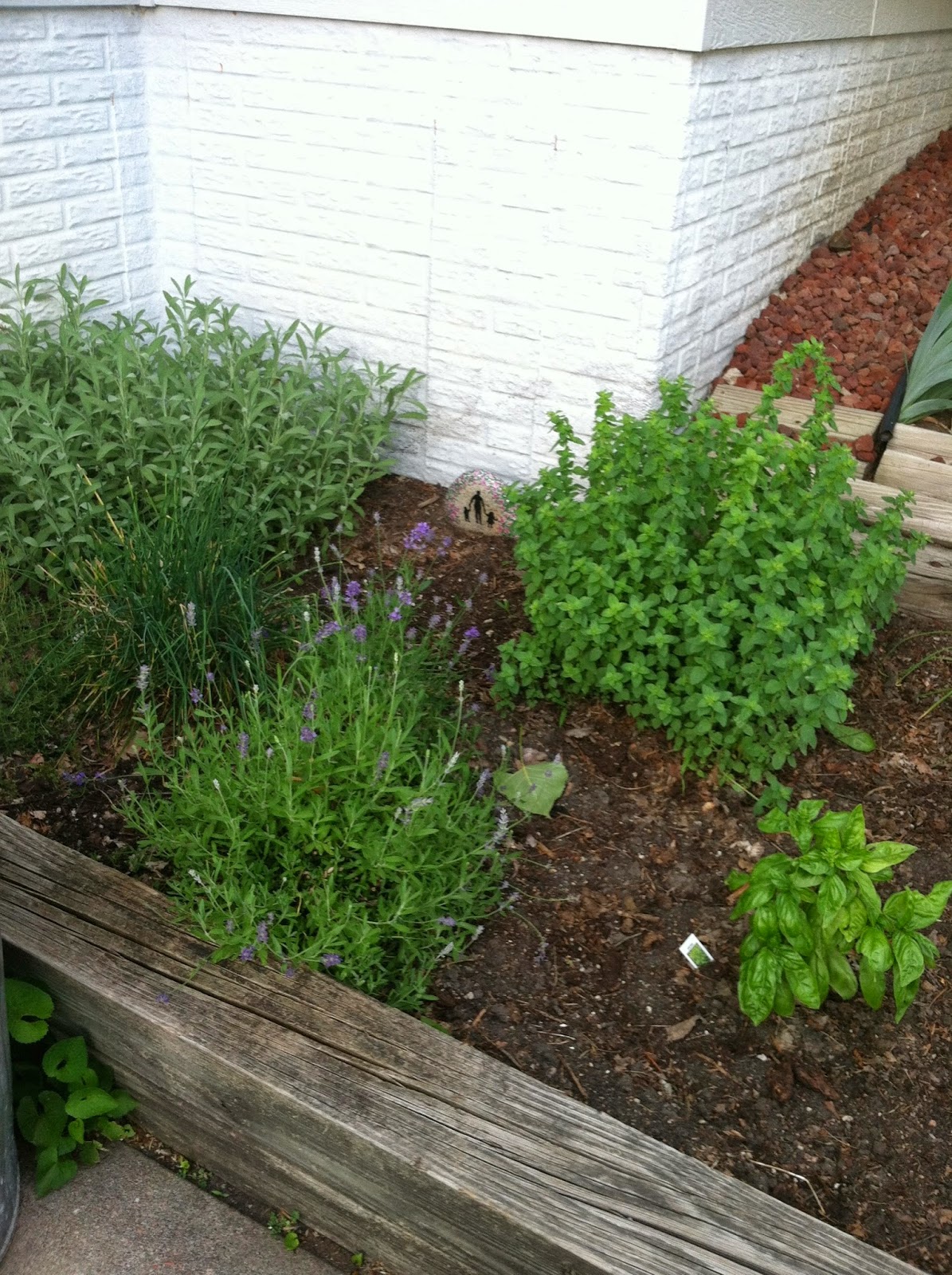
After I read about several local yard and garden tours, I began to write a poem about my ordinary garden. As I muddled around in the poem, I thought about my frugal approach to gardening. I grow vegetables, herbs, and perennials that do well in southeast Nebraska. I observe my yard for differences in sun, wind, shade, and water and then plant accordingly. Sometimes when plants don't thrive, I move them to a better location. If they die, I replace them by dividing a perennial that already grows in my yard. This year I tucked rosemary and tarragon in the bed along the fence because the location is sunny and protected from the wind. I plant basil near the tomatoes so both can be watered with the same drip hose. I water new plants to get them established but choose hardy herbs and flowers that withstand heat and wind. I conserve water and keep down weeds by mulching with grass and leaf clippings from the top of my compost bins.

About every two years, I get a good amount of rich composted soil from two large wire bins. This year, we added a covered tumbling bin so the table scraps won't attract possums and raccoons. Turning the compost in the bins makes my back ache so I hoped the ease of flipping the new bin would speed decomposition. Unfortunately, that hasn't happened. Like other worthwhile work, transforming raw materials into compost takes time.

All of this brings me back to the unfinished garden poem. After working on the poem several mornings in a row, I put the rough draft and notes in a folder to wait for work on another day. Will the poem be a tour of my garden, a comment about conservation, a story of my connections with plants like the rhubarb that comes from my grandparents' garden, or something else entirely? Often words and ideas or leaves and scraps make a fine risotto. Other times, the transformation requires a change in the ingredients and more time. Both benefit from stirring. While poems and compost brew, I am going out to pull weeds, dig black gold back into the ground, and enjoy the green colors. I plan to leave electronic devices indoors.


Thursday, June 12, 2014

Necessary Shawls


In this crazy world, I find wrapping a soft knitted shawl around my neck and shoulders is necessary. Old lady-ish or not, I have a few stalwart shawls that I wear around the house for warmth on cool evenings or mornings. I let the shawl rest on my shoulders and tie the ends into a loose knot. If the weather is very cold, I wrap up in a larger shawl and toss the ends over my shoulders. Comfort, not fashion, is my goal.  


Recently I finished knitting two warm weather shawls. Although they have a shade of plum in common, the patterns were quite different. Zephyr Cove by Rosemary Hill begins with a small leaf knit at one end of the shawl and ends with a simple lace pattern in a second color. Garter stitch short rows shape the shawl into a long boomerang. While the construction was interesting, it was the name of the pattern and the leaf drew me to the design. Hill named the pattern after a cove in Lake Tahoe and knit the original in teal blue and forest green. I'm not sure I'll knit a shawl with such an elongated shape again but the ends will wrap twice around my shoulders. I knit this shawl in fingering weight yarn, Tosh Merino Light.


The Red Robin Shawl by Helen Stewart is knit from Blue Sky Alpaca Silk. Stewart's pattern made a simple but elegant shawl. Her meticulous design includes an ingenious beginning which eliminates the pesky little point that sometimes happens at the beginning of triangular shawls. She also added a stitch to the edges that eliminates the awkward increases next to purl stitches. I had a few wobbly looking rows in the stockinette section of the shawl but blocking smoothed them out. I will probably knit this pattern again.

Shawl knitting offers a wide variety of designs. Some shawls come with intricate lace patterns while other create simple lines with stockinette or garter stitch. Shawls can be shaped in a crescent, rectangle (stole), large circle, triangle, or some variation of a shape. I happen to prefer a triangular shaped shawl for the straight forward construction and ease in wearing.  Summer is a great time for knitting a lightweight shawl, as the garment requires less attention to fit and finishing. Matching the pattern to yarn is a delightful process.  My advice for the summer is to choose a design, choose a yarn, knit, and enjoy. Then wrap up in your shawl and a book from your reading list.


Thursday, May 15, 2014

Spring News

After several rains, the trees and yards in my neighborhood are a glorious green. One yellow iris is blooming while others are growing lavender buds. Last week a Baltimore Oriole stopped for nectar in the neighbor's apple tree. Yesterday morning I was doing breakfast dishes when an unfamiliar bird caught my eye. I knew from his slender shape he was different from a robin so I studied him through binoculars and identified a brown thrasher. His rust-red colored back, cream and brown streaked breast, and yellow eye were striking. His long tail and curved beak also made him stand out from other birds that frequent my yard. Since this thrasher prefers a wooded area tangled with undergrowth, I wondered if Sunday's strong storm blew him off course. He was only in the yard for a few hours and I haven't seen him since. Hopefully he found his way back to more familiar territory.

The last few summers, my large perennial flower bed has grown wild and weedy. Taking advantage of cooler Spring days, I spaded up a strip four feet wide along the fence and in front of the shed. I dug out weeds and ruthlessly thinned and moved perennials that grow well in the space. I added tarragon, rosemary, and three gaillardia because they will grow if bindweed and larkspur don't choke them out. I potted some lemon balm for the patio and plan to share a few leftover plants with friends. Now I'm trying to decide whether to mulch. The bed gets a fair amount of hot Nebraska sun so mulch would keep moisture in the ground. If I mulch, I prefer using leaf and grass clippings mixed with a little dirt or compost over newspaper because the mixture will eventually break down and contribute to the soil. However anything I use will have to be anchored against the wind.

Inside on wet or rainy days, I used these two books as references, Cover to Cover and Book Craft, and made several small books of my essays. First, I manually formatted the essays into landscape orientation and made a mock-up for the book. I folded and assembled pages into three signatures (sections) before sewing and glueing them together. In separate steps, I glued end papers to the book block and a piece of mesh fabric to the spine. Determining the correct size and spacing for the spine was tricky as it required measuring spaces to 1/16th of an inch. Making the cover reminded me of covering school text books with grocery sacks on my parents' kitchen table.

           
Nothing made by hand is perfect and these four little books are no exception. Although I revised and edited the copy many times, I found two typographical errors. Two of the books have spines that are a little too wide. I did manage to make two copies in which the the book block sits remarkably well inside the cover. The notion of handcrafting a container for my writing appeals to me. I have also learned a book is worth the price on its cover.   


Wednesday, April 16, 2014

Knitting into Spring

Last winter I ripped out several knitting projects and reknit the yarn into wearable objects. This winter, I knit one pair of socks, several pairs of fingerless mitts, and washcloths to give as gifts. I combined leftover yarns into a Downtown Cowl and knit a Zilver shawl using the last skein purchased on a trip to the Wisconsin Wool Festival, September 2011. Then I finished a sweater. I am always a bit surprised when I knit a sweater that fits. My Current sweater is a success.

 In August 2013, I cast on the sweater in Breathless yarn, a merino/cashmere/nylon blend I had previously purchased for a large shawl. The yarn is a shade of sage green which reminds me of prairie grass being rippled by the wind. Shalimar Yarns named the color Limerick. The yoke and fronts of the sweater are trimmed in a checkerboard rib which includes a small cable twist reminiscent of a current of water meandering around the sweater.

As I knit, I thought about currents of all kinds. In rivers and streams, currents are diverted by sandbars, dead trees, and plants at the water's edge. Eventually the current creates a path by following gravity to lower elevations. If one watches long enough, patterns emerge. Moreover currents keep bodies of water from becoming stagnant. Water remains healthy when it circulates. Although currents of sound evaporate, they have a rhythm much like the rhyme in a limerick or sonnet. Ancient epic poems often acquired a rhythm as they were recited because rhythm helped storytellers  memorize and recall stories. The rhythm of poetry is part of its beauty. Currents of wind and air affect weather. Wind currents blow across grasses, through trees, neighborhoods, and open country. They leave evidence on rocks, mountains, lake surfaces, snow in ditches, and leaves against my garden fence. They shape trees in many places, including Interstate 80 through Nebraska. As the wind blew through autumn and winter, I knit on this sweater. I finished it about the time of the spring equinox. The lighter weight yarn makes this a good sweater for Spring.

Right now, I have three projects on my needles, a yellow sweater for a toddler, a pair of socks in a bright yarn variegated with yellow and blue, and a pair of fingerless mitts, also a soft yellow. I do believe I have put away the blue and gray yarns of winter. However, blue will be back in my knitting rotation come summer.

Nine months into retirement, I enjoy the changed pace in my life. For years I have wanted to savor Spring's arrival and now I can do that without being distracted by the end of the school year tasks. Late last summer I was diverted by a chickadee hanging upside down on a deck chair. In February, I watched the gradual change in light foreshadowing Spring. This week, despite Sunday's snow, buds are forming on the birch outside my window. The wind is blowing and I hope the prevailing current is toward Spring.